NOAH’S ARK AND MOUNT ARARAT
Hi everyone! We continue our blog series with the one which is frequently asked about: Noah’s Ark and Mount Ararat! In this content, we will explain all the details and travel tips that may guide you for your potential Turkey Tour!
LEGEND OF NOAH’S ARK TURKEY
The story of Noah’s Ark is one of the most enduring legends shared across multiple religions, including Christianity and Islam. It tells of humanity’s struggle with corruption, divine judgment, and the survival of life through faith and obedience.
In Christianity
According to the Bible, the Lord observed that humanity had become thoroughly corrupt, with evil thoughts prevailing in every action. God declared, “I will destroy from the earth the people I have created, along with animals, birds, and all living creatures” (Genesis 6:5–7).
Noah was the exception—a righteous man who obeyed God faithfully. He had three sons: Shem, Ham, and Japheth. God instructed Noah, “I will establish My covenant with you; take your wife, your sons, and their wives into the Ark” (Genesis 6:8–10, 18).
God commanded Noah to construct an Ark made of gopherwood, with three decks and a door, sealed inside and out with pitch. Noah followed every divine instruction (Genesis 6:13–22). He also gathered animals: seven pairs of each clean species, a pair of unclean species, and seven pairs of birds, ensuring the preservation of life (Genesis 7:2–3).
When the Flood came, rain poured for forty days and forty nights, and the waters rose to cover every hill and mountain. Noah, his family, and all the animals were safe inside the Ark. After 150 days, the waters receded, and the Ark came to rest on the Mountains of Ararat (Genesis 8:1–5).
To check if the land had dried, Noah first sent out a raven and then a dove. When the dove returned with an olive leaf, Noah knew the earth was ready. He and his family, along with the animals, left the Ark to begin life anew (Genesis 8:6–19).
Noah built an altar to offer sacrifices to God, who promised never again to destroy all life with a flood. God blessed Noah and his descendants to “be fruitful and multiply” (Genesis 8:20–22).
In Islam
The Islamic narrative of Noah (Prophet Nuh) similarly describes a world corrupted by sin, leading God to command Noah to construct an Ark. God specified its dimensions: 300 feet long, 50 feet wide, and 30 feet high.
While Noah built the Ark, disbelievers mocked him. Upon completion, he gathered all living creatures in male-female pairs according to God’s command. One of Noah’s sons refused to board the Ark, believing he could survive on a mountain. Then the flood began, lasting forty days and forty nights, covering the entire earth, submerging mountains and plains alike.
All living beings outside the Ark perished under God’s wrath, while Noah and the faithful were saved. The Ark sailed for 150 days until it came to rest on Mount Judi, located in the Ararat region. Noah released a dove to check for dry land; after returning empty, he sent it again seven days later, and it returned carrying an olive leaf, signaling the end of the flood.
Noah and the animals left the Ark, and he established a settlement at the foot of Mount Ararat to rebuild civilization. The story of Noah’s Flood has influenced numerous cultures and religions, from the Sumerians to modern Christianity and Islam.
Although the Ark remains a powerful symbol of faith, obedience, and divine mercy, its exact location and remains have yet to be discovered today.
MOUNT ARARAT
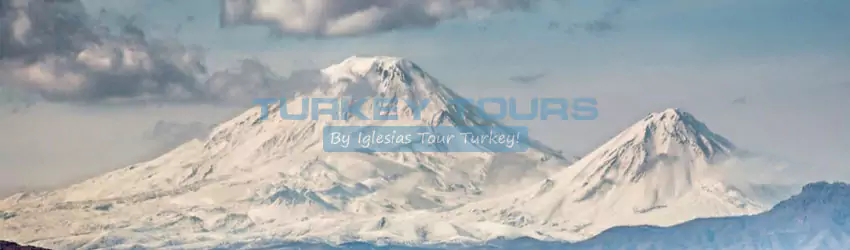
Mount Ararat is an inactive volcanic mountain located in eastern Turkey, within the Ağrı province. This majestic mountain consists of two ancient volcanic peaks: the main summit, known as Mount Ararat, and Little Ararat. The mountain is situated near the borders of present-day Turkey, Iran, Armenia, and Azerbaijan, making it a striking natural landmark in the region.
Mount Ararat rises to an impressive 5,137 meters (16,854 feet), making it the highest peak in Turkey, while Little Ararat reaches 3,925 meters (12,877 feet), ranking as the sixth-highest point in the country.
Beyond its natural grandeur, Mount Ararat holds profound cultural and historical significance. According to various legends and religious traditions, it is believed to be the resting place of Noah’s Ark following the great flood. This connection to ancient stories from multiple civilizations adds a unique sense of mystique to the mountain, attracting travelers, historians, and adventurers alike.
MOST ASKED QUESTIONS ABOUT NOAH’S ARK AND MT ARARAT
• Where is Mount Ararat located?
Mount Ararat is located in Eastern Turkey, within the province of Ağrı. It is situated near the borders of Turkey with Iran, Azerbaijan, and Armenia.
• Where is Noah’s Ark located?
No scientific study has definitively confirmed the location of Noah’s Ark. According to holy texts, after days of sailing on the floodwaters, the Ark finally came to rest on the summit of Mount Ararat. Based on these accounts, many believe Noah’s Ark is on Mount Ararat.
• How tall is Mount Ararat?
Mount Ararat rises to 5,137 meters (16,854 feet), making it the highest peak in Turkey. Little Ararat, its smaller neighbor, stands at 3,925 meters (12,877 feet), ranking as Turkey’s sixth-highest peak.
• Is Mount Ararat open for climbing?
Yes, Mount Ararat is open to climbers. The most popular route is via the southern sunny face, starting from the town of Doğubeyazıt, the nearest and most convenient access point. Climbing without local guides can be dangerous, so organized tours with professional guides—typically lasting 4–5 days—are recommended.
• What are the hottest months on Mount Ararat?
June, July, August, and September are the warmest months, with temperatures ranging from 28°C to 32°C. The coldest months are December, January, and February, averaging -6°C to -3°C.
• What is the average yearly precipitation on Mount Ararat?
Mount Ararat receives the most rainfall between March and June, with an average of 7.7 rainy days per month. The driest months are August, September, and October, with an average of 2 rainy days per month.
• Is Noah’s Ark on Mount Ararat?
Noah’s Ark and the Great Flood have been a subject of fascination across civilizations and religions for thousands of years. Although no definitive archaeological evidence has been found, religious texts indicate that the Ark rested on Mount Ararat after the Flood.
• How did Mount Ararat get its name?
The name “Ararat,” as mentioned in the Bible, is the Hebrew equivalent of Urartu, an ancient kingdom that thrived between the Aras and Upper Tigris rivers from the 9th to 7th centuries BCE. Thus, Mount Ararat is believed to have derived its name from the Urartu civilization.
• What is the significance of Mount Ararat?
Mount Ararat is traditionally recognized as the resting place of Noah’s Ark after the Great Flood, giving it major religious and historical significance.
• How big was Noah’s Ark?
Different sources provide varying dimensions. In Islamic tradition, the Ark measured 300 feet in length, 50 feet in width, and 30 feet in height.
• How long did it take to build Noah’s Ark?
According to historical and religious accounts, the Ark took approximately 55 to 75 years to build. Noah was said to be around 500 years old when he started construction, following God’s command.
• How many people were on Noah’s Ark?
Noah, his wife, his three sons—Shem, Ham, and Japheth—and their wives were the human occupants of the Ark, as instructed by God.
• How many animals were on Noah’s Ark?
While some sources claim up to 70,000 animals were aboard, the exact number is unknown. According to the Bible, Noah brought seven pairs of all “clean” animals and one pair of all “unclean” animals, along with seven pairs of birds of each species, to ensure the survival of all living creatures (Genesis 7:2–3, ESV).
NOAH’S ARK AND MT ARARAT TOURS
It is a pretty popular tour & activity for trekking and climbing lovers. These Tours are generally lasting 4 days; In addition to a wonderful climbing experience to Mount Ararat(the highest mountain in Turkey), it also offers the opportunity to explore historical and cultural structures (Ishak Pasa Palace from the Ottoman period and Dogubeyazit Town).
If you are one who does not like climbing to high altitudes, there are some 1-day tours to Dogubeyazit Town, Noah’s Ark, and Meteor Crater. If you wish to have more details about these Tours, you may contact our team.
Continue reading our blog posts and benefiting from useful information to plan your Turkey Tours smoothly. If you ever need help with creating your itinerary or have questions, do not hesitate to contact our team! We also recommend you reading our post about Cappadocia which is the most popular touristic destination in Turkey! If you liked our posts, do not forget to share them with your friends!
[2025 Update] Mount Ararat (Ağrı Dağı) remains a bucket-list destination for trekkers, pilgrims, and biblical history enthusiasts in 2025. Climbing permits are required and must be obtained through official channels in advance — the process has been streamlined in recent years but still requires planning several months ahead. The best trekking season is July through September, when weather conditions are most favorable. For those unable to attempt the summit, the Ishak Paşa Palace near Doğubayazıt offers a breathtaking architectural experience against the backdrop of Ararat and is accessible as a day trip from eastern Turkey’s main hubs.
Ready to explore Eastern Turkey? Browse our 7-Day Turkey Itinerary designed for history lovers, or discover our popular Archeological Tours of Turkey covering 10 must-see ancient sites. Those interested in ancient mysteries may also enjoy our guide to Göbeklitepe, humanity’s oldest temple, located in southeastern Turkey.
CATEGORIES