APHRODISIAS TURKEY AND 5-HIGHLIGHTS OF APHRODISIAS ANCIENT CITY!
Hi everyone! Welcome back to our blog series. In this post, we’ll take you on a journey through Aphrodisias Ancient City and highlight 5 must-see attractions that will help you make the most of your visit. Whether you’re a history enthusiast or just exploring Turkey’s incredible archaeological sites, these tips will ensure you don’t miss any of Aphrodisias’ treasures!
THE DISCOVERY OF APHRODISIAS TURKEY
In 1958, the renowned photographer Ara Güler was assigned to capture the beauty of Kemer Dam. However, when their driver lost the way, they unexpectedly stumbled upon the charming village of Geyre.
The village was remarkable — the walls of the homes were adorned with architectural fragments and columns, and many sarcophagi were repurposed for pressing grapes and olive oil. Intrigued, Ara Güler documented the village and its artifacts through photography. Initially, his photos didn’t attract much attention in Istanbul. As a final attempt, he sent them to The New York Times, where they received widespread recognition and admiration.
It was later revealed by American archaeologists that beneath the village lay a large ancient Roman city dedicated to the goddess Aphrodite. Inspired by this discovery, Prof. Dr. Kenan Erim from New York University contacted Ara Güler, and together they began to explore Aphrodisias further.
Excavations officially began in 1961, led by Kenan Erim, who fell in love with the city. He dedicated the rest of his life to Aphrodisias, and upon his death on November 3, 1990, his tomb was built in front of the Tetrapylon (monumental gate) of the ancient city.


HISTORY OF APHRODISIAS ANCIENT CITY!
Today, one of the most important and richest archaeological sites in Turkey is Aphrodisias, in the southwest of Turkey lies on the edge of the Büyük Menderes River.
The city is named after Aphrodite, the goddess of love and beauty, and is one of the rare ancient cities where remarkable artifacts from the Hellenistic, Roman, and Byzantine periods have survived to the present day.
Dating back to the 5th century BC, Aphrodisias had an estimated population of 20–25 thousand. In the 2nd century, the city was rebuilt with a grid plan, and the temple dedicated to Aphrodite elevated it to the status of a City-State (Polis). As a religious and cultural center, it flourished and became one of the largest spiritual hubs of the era.
The city’s golden age began in the 1st century, when strong ties with the Roman Empire brought wealth and prestige. Emperor Octavian himself declared, “I chose this city for myself from all over Asia,” leading to major investments, tax exemptions, and privileges granted by the Roman Senate. Over the next 200 years, Aphrodisias developed further, constructing magnificent marble structures.
Aphrodisias also housed the most important sculpture school in the Mediterranean world. Sculptors trained here gained fame throughout the Roman Empire, and their extraordinary works can still be admired today in the museum of Aphrodisias and among the ruins.
The city’s wealth is evident in its temples, odeon, stadium, theater, and elaborate sculptures, all built with high-quality marble from local quarries. Aphrodisias was renowned as the center of sculpting in the Asian province of the Roman Empire.
In addition to monumental architecture, Aphrodisias featured baths, agora, odeon, theater, and a stadium capable of seating around 30,000 spectators, one of the most impressive of antiquity.
With the division of the Roman Empire, the city became part of the Byzantine Empire. By the 4th century, it was an important episcopal center, though the Aphrodite cult persisted, leading to the martyrdom of two notable saints.
In the 7th century, the city was renamed “Stravpoli” (City of the Cross), erasing its pagan heritage, and later became known as Kayra (Caria).
Like many ancient cities in the Aegean region — such as Ephesus, Miletus, Claros, and Colophon — Aphrodisias suffered frequent earthquakes, leaving visible damage that can still be seen in restored structures today.
The city ultimately declined due to political and religious conflicts in the 7th century. Between the 11th and 13th centuries, the Seljuks ruled the region. In the 15th–16th centuries, the area was resettled due to fertile lands, giving rise to the present-day Geyre village.
5 MUST-VISIT HIGHLIGHTS OF APHRODISIAS
The ancient city of Aphrodisias is a treasure trove of historical architecture and cultural heritage. With countless sites to explore, here are five must-see highlights for your visit:
1. Aphrodisias Tetrapylon
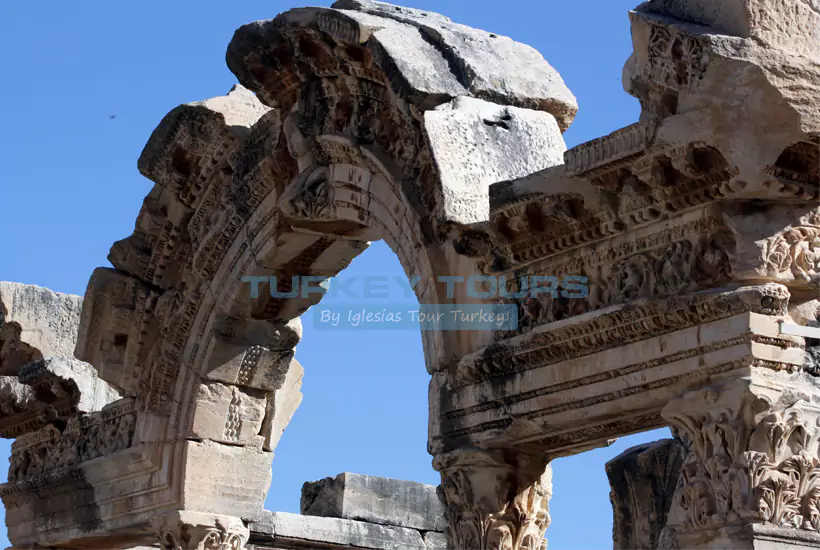
The Tetrapylon is a monumental structure with four columned entrances, built over approximately 150 years by the city’s talented sculptors. It served as the gathering point for ceremonial processions heading to the temple. Recently restored using 80% of the original pieces, it stands as a testament to the remarkable craftsmanship of Aphrodisias’ ancient artisans and a fine example of classical Roman architecture.
2. Aphrodisias Stadium
The stadium is one of the city’s most impressive structures, accommodating 30,000 spectators. Measuring 270 meters long and 50 meters wide, its elliptical design provided excellent views for everyone. This well-preserved arena is not only one of Turkey’s finest ancient stadiums but also one of the best in the world. Historically, it hosted Greek games, festivals, and public voting, and its large capacity suggests many visitors traveled from outside the city, boosting Aphrodisias’ economy.
3. Temple of Aphrodite
Dedicated to the goddess Aphrodite, this temple dates back to the archaic period. Excavations show construction began in the 1st century BC and was completed around 130 AD, with further expansions under Emperor Hadrian. Serving as a pilgrimage site, it was believed to protect those seeking refuge. The temple’s statue of Aphrodite, along with intricate reliefs, is now displayed in the Aphrodisias Museum. By the 5th century AD, the temple was converted into a church as Christianity spread in the region.
4. Bouleuterion (Odeon) of Aphrodisias
The Bouleuterion, built around the 2nd century AD, was the city’s council or parliament building and also hosted concerts and private performances for the emperor’s guests. With a 1,700-person capacity, its roofed structure features mosaics and statues of prominent statesmen and wealthy patrons, honoring those who funded its construction. Though the city practiced democracy, governance was heavily influenced by affluent families aligned with Rome. Many of the building’s magnificent sculptures can now be admired in the Aphrodisias Museum.
5. Aphrodisias Museum
Situated next to the ancient city, the Aphrodisias Museum preserves masterpieces of Anatolian sculpture from Roman and Byzantine periods. Highlights include inlaid sarcophagi, colossal reliefs, and exquisite statues, offering visitors a rich understanding of the city’s artistic and cultural heritage.
FINAL THOUGHTS
Aphrodisias was one of the most significant cities of its time and remains one of Turkey’s most remarkable ancient ruins today. Exploring the site may take several hours, but it is well worth the visit. This peaceful and less-crowded destination allows travelers to uncover the rich historical legacy left behind by both the Byzantine and Pagan eras.
To create your best Turkey Tours schedule, continue reading our contents and benefiting them!
If you liked our posts, do not forget to share it with your friends!
CATEGORIES