ANCIENT CITY OF TROY AND TROJAN WAR!
Hi everyone! We continue our blog series with one of Turkey’s most iconic historical treasures. The Ancient City of Troy shines with its rich history, legendary culture, and enduring significance from antiquity to the present day.
In this post, we’ll take you on a journey deep into the past, exploring the Ancient City of Troy, the Trojan War, and answering the most frequently asked questions about this legendary site.
MOST ASKED QUESTIONS
Where is the Ancient City of Troy?
The Ancient City of Troy was strategically located on the west coast of Asia Minor. Today, its ruins lie within the boundaries of Çanakkale, Turkey. In antiquity, Troy held a crucial strategic position, overseeing the Marmara Sea, which connects the Black Sea to the Aegean Sea, making it a key hub for trade and military control.
Who excavated the Ancient City of Troy?
The first archaeological excavations at the Ancient City of Troy were conducted by Heinrich Schliemann in 1870. Although Schliemann was primarily a merchant by profession, he pursued archaeology as an amateur enthusiast, driven by his fascination with Homer’s epics. His discoveries at Troy laid the foundation for modern archaeological studies of the legendary city.
Who discovered the Ancient City of Troy?
The Ancient City of Troy was first brought to light by Heinrich Schliemann, one of the most successful merchants of his time. Fluent in 11 languages, Schliemann conducted trade across major countries such as Italy, Germany, and the Soviet Union.
His fascination began when he read Homer’s Iliad, which describes a magnificent city and a war that lasted ten years. Inspired, Schliemann devoted his wealth and energy to uncovering the legendary city.
In 1868, he began his excavation efforts, facing numerous diplomatic and logistical challenges. Finally, in 1870, just as he was about to abandon his search, Schliemann discovered the Treasure of King Priam in the second layer of Troy, confirming that he had found the ancient city.
When was Troy discovered?
The legendary city of Troy was discovered in 1870 by Heinrich Schliemann, an amateur archaeologist and successful merchant. His excavation brought to light one of the most iconic sites of ancient history, connecting the stories of Homer’s Iliad with real historical findings.
Was the Trojan War real
The Trojan War has long been a mix of myth and history. Ancient sources like Herodotus, Eratosthenes, and Homer suggest it was a real conflict. Archaeological discoveries by Heinrich Schliemann at Troy support this, revealing layers of ancient cities that hint at real battles.
While the stories of gods and heroes are legendary, the war itself likely happened in history, showing how myth and reality often intertwine.
When was the Trojan War?
The exact date of the Trojan War remains a mystery, but historians generally place it around the 12th to 11th centuries BC. Ancient sources, including Eratosthenes, provide estimates, and archaeological findings at the site of Troy give us further clues. Excavations have revealed layers of destruction, suggesting a major catastrophe struck the city, with evidence pointing to roughly 1194–1184 BC.
While we may never know the precise dates, combining historical records and archaeological data helps us piece together a likely timeline for this legendary conflict. The war, whether partly myth or fully historical, remains one of the most fascinating events of the ancient world.
What caused the Trojan War?
The legendary Trojan War is said to have been triggered by a dramatic event: the kidnapping of Helen, the wife of Mycenaean King Menelaos, by Paris, the prince of Troy, during a diplomatic visit to Sparta. This act of abduction not only insulted Menelaos but also set off a chain of events that led to a full-scale war between the Greeks and the Trojans.
While myths often embellish the story with gods and heroic feats, the kidnapping of Helen remains the central cause in both ancient writings and later interpretations, symbolizing how personal conflicts could escalate into historic battles in the ancient world.
How long did the Trojan War last?
According to Homer’s Iliad, the Trojan War lasted for 10 years. This decade-long conflict saw countless battles, heroic feats, and legendary figures on both sides. While the exact historical timeline is uncertain, the 10-year duration has become a defining feature of the story, highlighting the war’s intensity and the enduring struggle between the Greeks and Trojans.
The length of the war also reflects the strategic and emotional stakes involved, showing how a single event—the kidnapping of Helen—could spark a conflict that raged for a generation.
Who fought in the Trojan War?
The Trojan War was fought between the Greeks and the inhabitants of Troy, a city located in what is now northwestern Turkey. Legendary heroes such as Achilles, Odysseus, and Hector played key roles in this epic conflict, which combined both historical battles and mythological tales.
The war not only pitted two civilizations against each other but also showcased the complex interplay of honor, revenge, and destiny, making it one of the most famous conflicts in ancient history.
Who won the Trojan War?
After 10 long years of fierce battles, it was the Greeks who emerged victorious in the legendary Trojan War. The fall of Troy is famously attributed to the clever use of the Trojan Horse, a deceptive strategy that allowed Greek soldiers to infiltrate the city and bring an end to the decade-long conflict.
This victory not only marked a turning point in Greek mythology but also became a timeless story of strategy, heroism, and the consequences of pride and rivalry.
ANCIENT CITY OF TROY
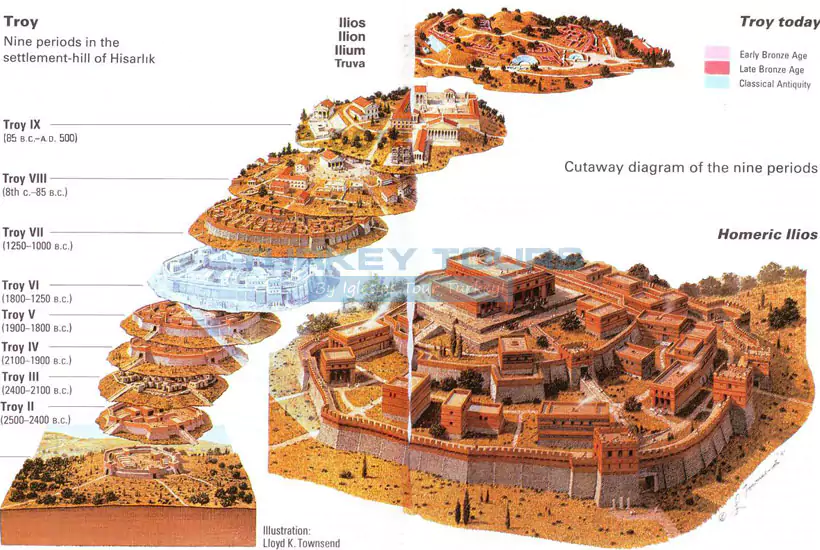
The ancient city of Troy, which is about 30km from Çanakkale center (about 350 km away from Istanbul), is located on the Hisarlık Hill on the Anatolian side of the Çanakkale Strait. The ancient city of Troy hosted 9 different civilizations between 3000 BC and 400 AD, thanks to its commercial location, harbor, and fertile lands. The city of Troy, which has 9 different layers, was destroyed many times due to natural disasters and is a mound built on the same hill again. During the long years of excavations, artifacts and settlement traces of each layer were found.
Especially the sea trade from Troy port is thought to cover the Aegean, Mediterranean, Marmara, and the Black Sea. Nowadays, it is not possible to see the harbor view when you visit to the ancient city of Troy. As in the Ancient City of Ephesus, alluviums filled the harbor in Troy too.
While visiting the ancient city of Troy, you will not see a complete and well-preserved Roman or Ancient Greek City like the one you see in Ephesus Ancient City or Aphrodisias Ancient City. But once you learn about its historical and mythological story, you realize how important and glorious place you visit at that moment.
The ancient city of Troy with a great reputation in the world not only in Turkey; It has managed to survive to the present day with its rich cultural heritage. And, was included in the UNESCO World Heritage List in 1998. 2018 was declared the year of Troia, as it is the 20th anniversary of the acceptance of the Ancient City of Troy to the UNESCO world heritage list.
FIRST EXCAVATIONS IN ANCIENT CITY OF TROY!
The first excavations at the ancient city of Troy were carried out in 1870 by the amateur archaeologist Heinrich Schliemann. Inspired by Homer’s epic Iliad, Schliemann believed that Troy was located on Hisarlık Hill, south of the Dardanelles, and began his pioneering work there.
Three years into the excavation, Schliemann discovered the famous Priam’s Treasure in the second layer of the city. He controversially smuggled these artifacts to Germany, later donating them to the Berlin Museum. However, during World War II, the treasures were seized by Russia, and today, many of these ancient artifacts are displayed at the Pushkin Museum in Moscow.
Schliemann’s work, despite its controversies, laid the foundation for modern archaeology in Troy and confirmed that the legendary city described in the Iliad had a real historical counterpart.

MYTHS IN TROY AND HOMER!
The ancient city of Troy, located at the foothills of the Kaz Mountains, is as famous for its mythology as it is for its history. According to Greek myths, the first recorded beauty contest in history took place here, featuring Hera (wife of Zeus), Athena (goddess of wisdom), and Aphrodite (goddess of love and beauty). Aphrodite promised Paris, the judge of the contest, the love of the world’s most beautiful woman in exchange for being chosen the winner. Paris accepted and subsequently kidnapped Helen, the queen of Sparta, sparking the legendary Trojan War.
Much of what we know about Troy and the war comes from the renowned Greek poet Homer, who wrote the Iliad and the Odyssey, chronicling the final 51 days of the decade-long conflict. These epic poems have captivated readers for centuries and remain among the most celebrated works of literature in the world.
Troy’s mythological fame has even inspired modern culture, most notably Hollywood’s 2004 film “Troy”, starring Brad Pitt. The movie helped bring the city to global attention, turning it into a must-visit destination for millions of tourists. One of the highlights is the iconic Trojan Horse, located in the center of Çanakkale, a gift from the film production. Visitors can also see and climb a similar replica at the ancient city of Troy, enjoying panoramic views from its upper levels—a perfect blend of myth, history, and breathtaking scenery.
THE TROJAN WAR!
The Trojan War, which raged for 10 years, continues to fascinate people even centuries later. Immortalized by Homer in his epic poetry and celebrated by Greek and Roman artists, this legendary conflict captures the imagination like no other. It is easy to see why—it is a story of love and passion, courage and revenge, pain and loss, all set against the backdrop of one of history’s most famous cities.
The war began with the abduction of Helen, the most beautiful woman of her time, and unfolded across Anatolia, culminating in the tragic fall of Troy. This was no ordinary battle—gods and goddesses themselves took part, influencing the course of events and the fates of heroes. The Trojan War remains a timeless tale of human emotion and divine intervention, continuing to inspire literature, art, and film even today.
BIRTH OF PARIS (Heir to the Throne of Troy)
In the 13th century BC, the Trojan King Priamos and Queen Hekabe were expecting a son, who would be named Paris. Days before his birth, Hekabe had a terrifying dream: a flame emerging from her womb would engulf all of Troy. The oracles interpreted the vision as a bad omen, warning that the child would bring destruction to the city.
Fearing this prophecy, King Priamos abandoned Paris on the foothills of the Goose Mountains, leaving him to die. Fortunately, a shepherd family discovered the baby and raised him as their own. Paris grew up unaware of his royal lineage, living a simple life as a shepherd—until the fateful moment when he was chosen to judge a divine contest between the three goddesses of Olympus, a decision that would ultimately seal his destiny and set the stage for the legendary Trojan War.
LEGEND OF 3 BEAUTIES
The story begins with Eris, the goddess of chaos and discord, being snubbed from the wedding of the sea goddess Thetis. Angered by the insult, Eris throws a golden apple inscribed with “To the Most Beautiful”, sparking a divine contest. The contenders are Hera (wife of Zeus), Athena (goddess of wisdom), and Aphrodite (goddess of love and beauty).
To settle the matter, Zeus appoints Paris, the Trojan prince, as the judge. Each goddess tries to sway him with tempting promises: Hera offers dominion over Asia, Athena promises wisdom and victory, and Aphrodite pledges the love of the most beautiful woman in the world, Helen, wife of the Spartan king Menelaos. Captivated by Aphrodite’s offer, Paris awards her the apple, a decision that would ignite the chain of events leading to the Trojan War.
TROJAN WAR BEGINS!
Years passed, and Paris, now heir to the Trojan throne, visited Sparta on a diplomatic mission. Captivated by the beauty of Queen Helen, he kidnapped her and returned to Troy. This act of abduction enraged King Menelaos, who, determined to reclaim his wife and restore his honor, organized a Greek expedition to Troy with the support of his brother, Agamemnon.
According to Homer’s Iliad, the war saw remarkable events unfold over ten years, as the Greeks struggled to breach the formidable walls of Troy. Achilles, the greatest Greek hero, initially withdrew from the fight after Agamemnon claimed Briseis, a reward meant for him. His fury reignited only after the death of his close friend Patroclus at the hands of Hector.
In a legendary duel, Achilles killed Hector and dishonorably dragged his body behind his chariot. It was only after King Priamos secretly approached Achilles’ tent, offering a ransom, that Hector’s body was returned to the Trojans for a proper burial. Hector’s death marks the climactic moment in the final part of the Iliad, symbolizing both the tragedy and heroism of the Trojan War.
THE DEATH OF AKHILLEUS
After the tragic death of Hector, the Trojans continued to fiercely defend their city, but Achilles and the Greek forces dominated the battlefield. Before joining the war, Achilles’ mother, Thetis, had warned him that he was fated to die young.
True to the prophecy, Achilles met his end at the hands of Paris, the very prince whose abduction of Helen sparked the war. Paris struck Achilles in his heel, his only vulnerable spot. According to legend, Thetis had dipped Achilles in the River Styx to make him invincible, but his heel—by which she held him—remained unprotected. This iconic moment immortalized Achilles’ name, and today, the tendon in the heel is still called the “Achilles tendon” in his honor.
THE FALL OF TRUVA
In a brilliant act of deception, the Greeks pretended to retreat from the war and executed a cunning plan devised by Odysseus, the King of Ithaca. They hid their soldiers inside a massive wooden horse, leaving it at the gates of Troy as a supposed gift from the gods. Believing the war was over, the Trojans brought the horse inside their city walls.
Under the cover of night, the Greek soldiers emerged, opening the gates for the rest of their army. They captured the women and ruthlessly defeated those who remained, marking the final fall of Troy. This legendary act of strategy and cunning immortalized the Trojan Horse as a symbol of clever warfare and the dramatic end of the Trojan War.
HOW YOU CAN GET TO TROY TODAY?
The Ancient City of Troy is located on the Anatolian side of the Dardanelles. There is no airport and no train transportation to Troy. The only way you can get to Troy Ancient city is by Road Transportation. It is 30 km away from Çanakkale City Center, roughly 400 km away from Istanbul, 300 km away from Bursa, and 310 km away from Izmir.
If you are thinking to Travel to Troy from Cappadocia or Antalya (such cities far away), it is smarter to take a flight to Istanbul, Bursa, or Izmir. Then, take road transport to Troy. This road transport might be private transfer, or renting a car since there are no direct busses which will take you to the entrance of Troy Ancient City!
FINAL THOUGHTS!
The Ancient City of Troy is a very important destination that started from the Ancient Greeks and hosted many Anatolian civilizations. As mentioned above, there are 9 separate layers. Each of these layers carries traces from a different period and a different community.
The first layer is dated between 3000 and 2500 BC. The last (9th) layer is dated to the Eastern Roman Empire and carries traces from between the 1st century BC to the 1st century AD. That is why it was the subject of Homer’s epic The Iliad and Hollywood. Today, millions of travelers visit this Ancient site, which is also included in the Unesco World Heritage list.
The most important advice we can give you might be: Troy Ancient City is not a well-preserved and complete destination like Ephesus Ruins. If you prefer to travel on your own, and you do not have advanced archeology knowledge, you may not be very pleased with this visit!
Therefore, you can choose one of our Private Guided Tours to Troy Ancient City. Departing from Istanbul, Bursa, Izmir, Selcuk, or Kusadasi; There are tours that include transportation, guiding, entrance fees, parking fees, and lunch. When you book one of these tours, you don’t have to worry about anything else. Our professional team will take you from the door of your hotel, you will have a wonderful experience and you will return to your hotel again…
In any way, we hope that you can collect some useful information from this content and create your smooth-running Travel Plan to Troy Ancient City. We also highly recommend you to read our post about Cappadocia, one of the most popular destinations of Turkey, before planning your Trip! If you liked our posts, do not forget to share it with your friends!
CATEGORIES